How to Make Your Garden a Bird-Friendly Habitat: A Practical Conservation Guide
Your garden is not separate from the countryside around it. To a blue tit working its way along a hedgerow, it is simply the next patch of ground — and what it finds there decides whether it stays, nests, or moves on.
A garden that works for birds is rarely a tidy one. It is layered, full of insects, and slightly neglected in the right places. The encouraging part is that most of the changes take an afternoon, and after that the garden largely does the work itself.
Native trees and shrubs support far more caterpillars, aphids and other invertebrates than most imported ornamentals, and those invertebrates are what birds actually feed their young on. A single pair of blue tits can get through hundreds of caterpillars a day during the nesting season. If your garden has nothing for the caterpillars to eat, it has nothing for the tits either.
Structure matters as much as species. A good bird garden has a canopy, a middle layer of shrubs, a hedge or two, and some rough ground at the base. Each layer suits different birds: dunnocks and wrens skulk in the low tangle, blackbirds and song thrushes work the leaf litter underneath, and goldfinches and siskins feed higher up.
If you are starting from scratch, these are reliable choices:
Ivy deserves a special mention. It flowers late, when little else does, and its berries ripen in late winter when resident birds are at their hungriest. A mature ivy-covered wall or fence is one of the most useful things in any garden.
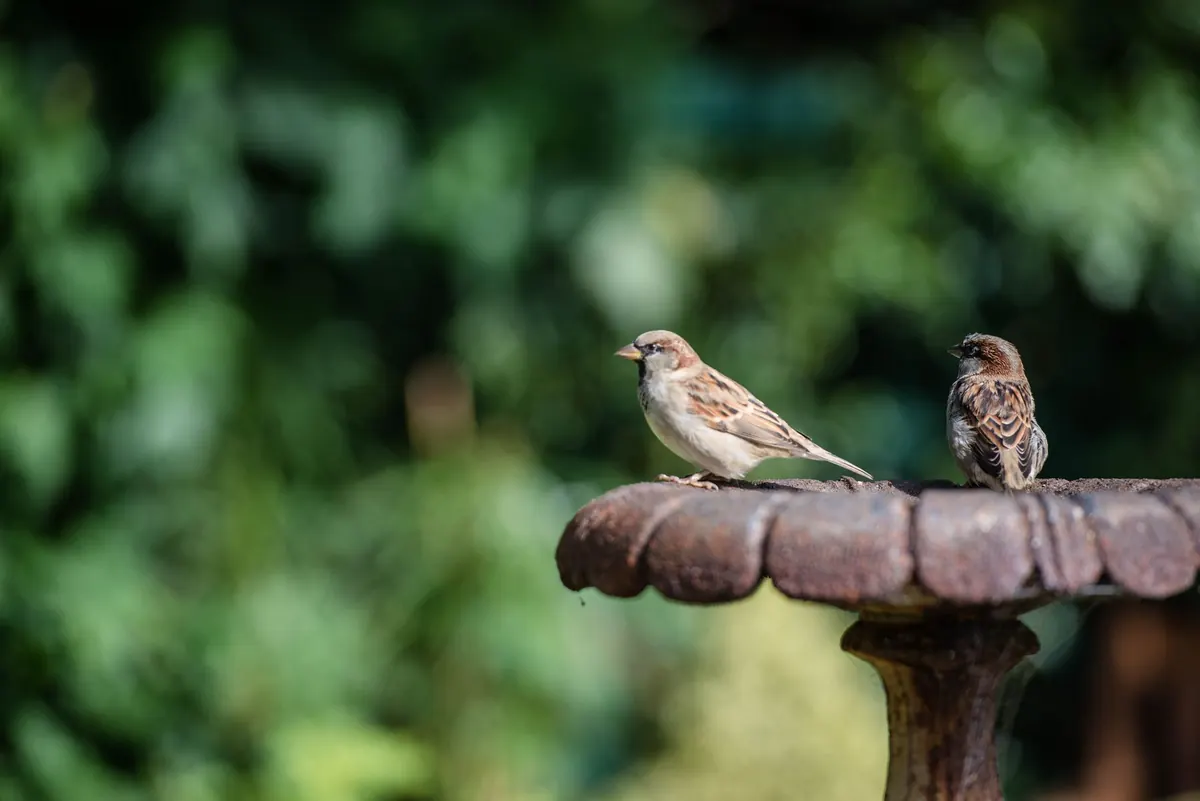
A bird bath does not need to be grand. It needs to be shallow, with gently sloping sides and a rough surface underfoot so birds can grip. Add a few flat stones if the base is smooth or slippery. Deep, steep-sided containers are a drowning risk for smaller birds.
Position the bath a metre or two from a shrub, so birds have somewhere to retreat to, but not directly under a dense bush where a cat can lie in wait. Refresh the water every day or two in summer, scrub the bowl out with a stiff brush rather than chemicals, and keep it ice-free in winter — a floating ball or a jug of warm water each morning does the job. Birds need to drink and bathe all year, not just in a heatwave.
Buy boxes made from untreated wood, ideally around 15–18mm thick, which gives some insulation against summer heat and winter cold. Avoid boxes with a perch below the hole; perches help predators far more than they help tenants. A metal plate around the entrance hole is worth the small cost if squirrels or woodpeckers are a problem.
Match the box to the bird. Roughly:
Hang boxes two to four metres up, facing somewhere between north and east so they avoid the worst of the sun and driving rain, and tilt them very slightly forward so water runs off. Keep them away from feeders, where traffic and squabbling cause disturbance. Space tit boxes out rather than clustering them, and clean old nests out in autumn once the breeding season is finished. Scrape the box out and dispose of the contents; skip the insecticides.
Sparrowhawks, magpies and jays take birds and eggs, and there is nothing you can or should do about that. It is natural predation, and a garden with a sparrowhawk in it is usually a garden with plenty of birds to start with. Keep feeding.
Domestic cats are a different matter. If a neighbour's cat is a regular, bells and high-visibility collars help a little, but placement helps more: keep feeders at least two metres from anything a cat can hide behind, and site bird baths with a clear approach. Feeders on a pole with a baffle are far safer than ones hung low in a shrub.
Rats are drawn by spilt food. Use trays under feeders, sweep up husks, store seed in a metal bin, and take hanging feeders in at night if you have a persistent problem. A clean feeding station is the simplest deterrent there is.
Slug pellets, weedkillers and insect sprays do not stay where you put them. They move up the food chain, and the insects they remove are precisely the ones chicks need. A blue tit brood can consume thousands of caterpillars before it fledges, so an aphid-free rose bush is, from a bird's point of view, an empty one.
That means tolerating some holes in the leaves. Use barriers, beer traps or a torchlit evening patrol for slugs instead of pellets. Let clover and dandelions stay in the lawn — dandelion seed is a favourite of goldfinches — and if you must spray, do it in the evening when pollinators have gone to bed and never on a plant in flower.
Resist the autumn clear-up. Seed heads left standing feed finches right through the cold months, fallen leaves harbour the insects and grubs that blackbirds and thrushes turn over, and a log pile in a quiet corner will be colonised by beetles, fungi and, in time, wrens.
One hard rule: do not cut hedges or trim dense shrubs between March and August. Nesting birds are legally protected in the UK, and even a light trim can expose a nest.
You do not need to do everything at once, and a garden that changes slowly is easier to read. Start with one or two of these:
Then watch. Keep a rough note of what you see and when — which birds use the feeders, where they take cover, which shrubs they disappear into. Over a season or two, those notes will tell you more about your garden than any general guide, and you will start making decisions for the birds that actually live there.
Photo: Milan / Pexels
Previous Post
How to Photograph Birds at Garden Feeders: Settings, Perches and Lighting
Next Post
Five UK Coastal Walks for Seabird Watching in Spring and Summer